Why walk the Camino?

There are two general reasons people walk the Camino de Santiago.  When you arrive at Santiago de Compostela, you are asked if your purpose is for spiritual reasons or for cultural/historical reasons.  My main reasons for walking, as best as I can tell, are cultural, historical, environmental, and fraternal.  I want to see and experience northern Spain up close, including its villages, cities, Romanesque churches, art, food, wine, music, geology, and its international assortment of fellow travelers.

Much like a sabbatical, this time apart from normal life may give me some time to consider what I’d like to do with the rest of my life now that I’ve retired.  It should allow some perspective on some options to consider.  Or it may just make me want to get Christi and keep traveling!

Lastly, and after it’s all over, it will probably occur to me that the most important reason for walking this 800-kilometer trail will have been meeting friends I didn’t know I had, and walking each day with the memory of my good brother-like friend Daniel Hedrick.  Daniel recently left this world, even as we were planning more trips to mountain streams and the sharing of well-worn stories over beers and sitting late into the night at long dinner tables under the stars with new-found friends — much like what can be expected along the way of the Camino de Santiago.  It’s this walk, and all its grand purposes, that I dedicate to Dano.  And for that reason, I’m sure it will be spiritual.
Daniel Hedrick 1953 to 2016

Daniel Hedrick
1953 to 2016

“All journeys have secret destinations of which the traveler is unaware.” – Martin Buber

A bit of who I am

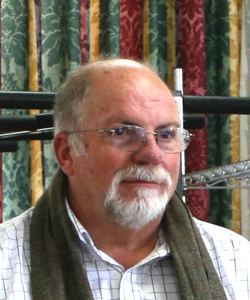
My face        I’m David Williams, a recently retired 65 year-old guy, living with my wife on the central coast of California, about midway between Los Angeles and San Francisco. We have always liked to travel: I lived in southern Italy for a year and a half a long time ago (and saw a lot of Europe), and as husband and wife we’ve traveled together in the US, and abroad to England, Italy, and sub-Saharan Africa. I ventured off to Tibet a few years ago, but, unfortunately, without my wife!

I spent a career as a geologist, working at various times in petroleum geology, engineering geology, and mostly hydrogeology (water below the ground). I think that whatever it was that made me interested in learning about geology, made me interested in exploring our world.

My wife and I love to cook and eat good food (of most any kind), and we do enjoy wine (a lot!). One of the best things about traveling is trying new foods, and sampling the local wine varietals.

That’s probably all you really need to hear about me. If you are walking the Camino the same time as I am, I hope our paths cross. If you’re back home, you would make my day if you contact me as the journey progresses. Thanks!

“The first condition of understanding a foreign country is to smell it.” – Rudyard Kipling

What is this all about?

People have been making long treks on the Camino de Santiago (the Way of St. James) since the ninth century primarily as a pilgrimage to a shrine in Santiago de Compostela where the bones of St. James were said to have been buried. The pilgrimage soon became the most widely known and most traveled Christian medieval pilgrimage. It was customary for returning pilgrims to carry with them a Galician scallop shell found at nearby Cape Finisterre as proof that they completed the journey. The legend passed down for over a thousand years says that the remains of St. James were miraculously carried on a boat made of cement and steered by an angel to Spain and placed at the site of the present Cathedral of Santiago de Compostela.

Since medieval times, the popularity of the pilgrimage would vary depending on conditions in Europe such as times of peace, times of war, the Spanish Inquisition, or the inspiring words of the current Pope. In the last 30 years or so, there’s been a dramatic surge of people walking the Camino. According to the Pilgrim’s Office in Santiago, 260,000 people walked the Camino in 2015.

“Pilgrim: A traveler that is taken seriously.” — Ambrose Bierce

It had to start somewhere

1/31/16
Sometime back in 1974, I read James Michener’s book “Iberia”. I was pretty intrigued by his account of the cathedral of Santiago de Compostela in Spain and the pilgrimage routes that people have been following since medieval times. Then after reading Hemingway’s “The Sun Also Rises” and still in my early 20s, a small group of us drove across the Atlantic coast of Spain, mostly surfing and exploring the sites along the way. Spain would need to be visited again.

That was the seed, and when the internet made it easy to discover more about Santiago de Compostela and the pilgrim routes, my interest was renewed. Then, while watching the movie “The Way” with Martin Sheen, I told Christi “Maybe we should do that, what do you think?” Being far from retirement age with not enough time to walk for 42 days, she gave me the go ahead, as long as she could meet me in Santiago and then travel on to Italy for a while!  So that’s our plan.

The trip is planned for a start in the foothills of the Pyrenees in Saint-Jean-Pied-de-Port (SJPP), France on May 14. 2016. There are several pilgrimage routes to Santiago, but the most popular route is the Camino Frances, beginning in SJPP, crossing the Pyrenees, and continuing on for 800 kilometers. There are loads of books and information on the internet, and phone apps regarding the Camino de Santiago – more than enough to plan a buen camino!

“Oh, the places you’ll go!” – Dr. Seuss